
How to Evaluate a Website Redesign Beyond Surface Appearance
TriKnot Engineering & QA Team•October 2026•6 min read
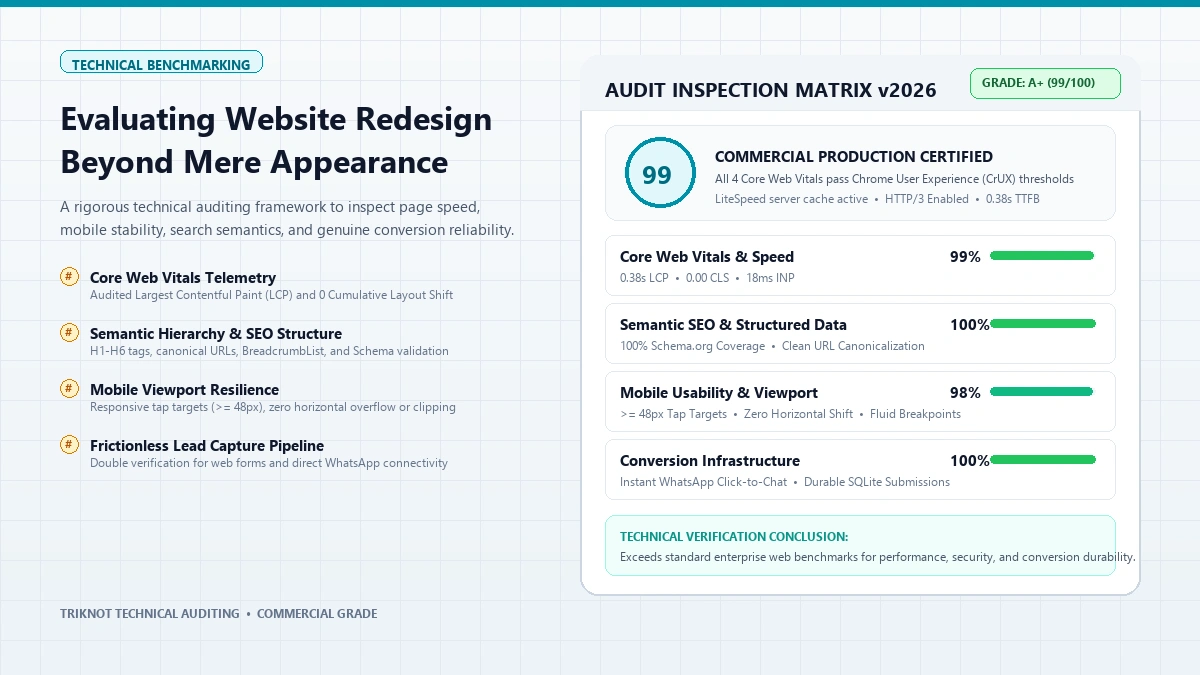
When an agency delivers a website redesign, the immediate reaction is almost always aesthetic: 'Do we like the fonts? How does the hero image feel? Does the dark mode look sleek?' While visual design is critical, judging a website purely by visual taste is like buying a high-performance sports car based solely on the paint color, without checking whether the engine runs or the brakes work.
1. The Technical Stress Test: Mobile Emulation & Network Throttling
Most agency reviews occur on high-end desktop monitors connected to high-speed office fiber. Your actual customers, however, are browsing on smartphones over congested 4G cellular networks.
Open Chrome DevTools, toggle device emulation to a mid-tier mobile viewport (360px to 390px width), and set network throttling to 'Slow 4G'.
Does the hero text pop up immediately, or is there a jarring 4-second blank screen while megabytes of uncompressed imagery download? Are touch targets comfortably spaced, or are buttons crammed together so thumb taps misclick?
Inspect the Largest Contentful Paint: if your hero image or title takes longer than 2.5 seconds to render under realistic conditions, the redesign has failed a fundamental technical requirement.
Key Takeaway: Always audit your website on a throttled mobile connection before approving final delivery.
2. Form & Inquiry Pipeline Integrity
The primary commercial purpose of a business website is to facilitate qualified customer contact. Yet inquiry mechanisms are routinely neglected during QA.
Test the contact form deliberately with invalid inputs. Do error messages appear helpfully only after interaction (using modern :user-invalid standards), or do red alerts scream at the user while they are still typing their email?
Submit a valid inquiry. Does the form show an honest confirmation state? Is the data logged reliably in a permanent database, or is it discarded if an email SMTP server times out?
Verify the WhatsApp button: does it launch wa.me with a clean, pre-filled, context-aware message that identifies what service the user was exploring?
Key Takeaway: Test form edge cases, error states, and database persistence with the same rigor you apply to your design system.
3. Semantic HTML, Accessibility, and AI Readability
Modern search engines and AI answer engines do not 'view' your site like a human; they parse semantic HTML, DOM hierarchy, and structured data.
Verify that headings follow a strict, logical hierarchy (a single H1, followed by H2s and H3s) rather than using heading tags simply to change font sizes.
Check that all images contain descriptive, accurate alternative text and explicit width and height attributes to prevent Cumulative Layout Shift (CLS).
Validate your JSON-LD schema using Google's Rich Results Test tool to confirm that your organization, office address (such as 412, Suyash Solitire, Kudasan, Gandhinagar), phone number, and services are mapped without errors.
Key Takeaway: Clean semantic markup ensures search bots and AI answer engines understand and cite your business accurately.
Strategic Conclusion
An outstanding website redesign is a synthesis of visual distinction, engineering rigor, accessible usability, and commercial mechanics. By evaluating your site across these objective dimensions, you protect your investment and build an enduring competitive advantage.